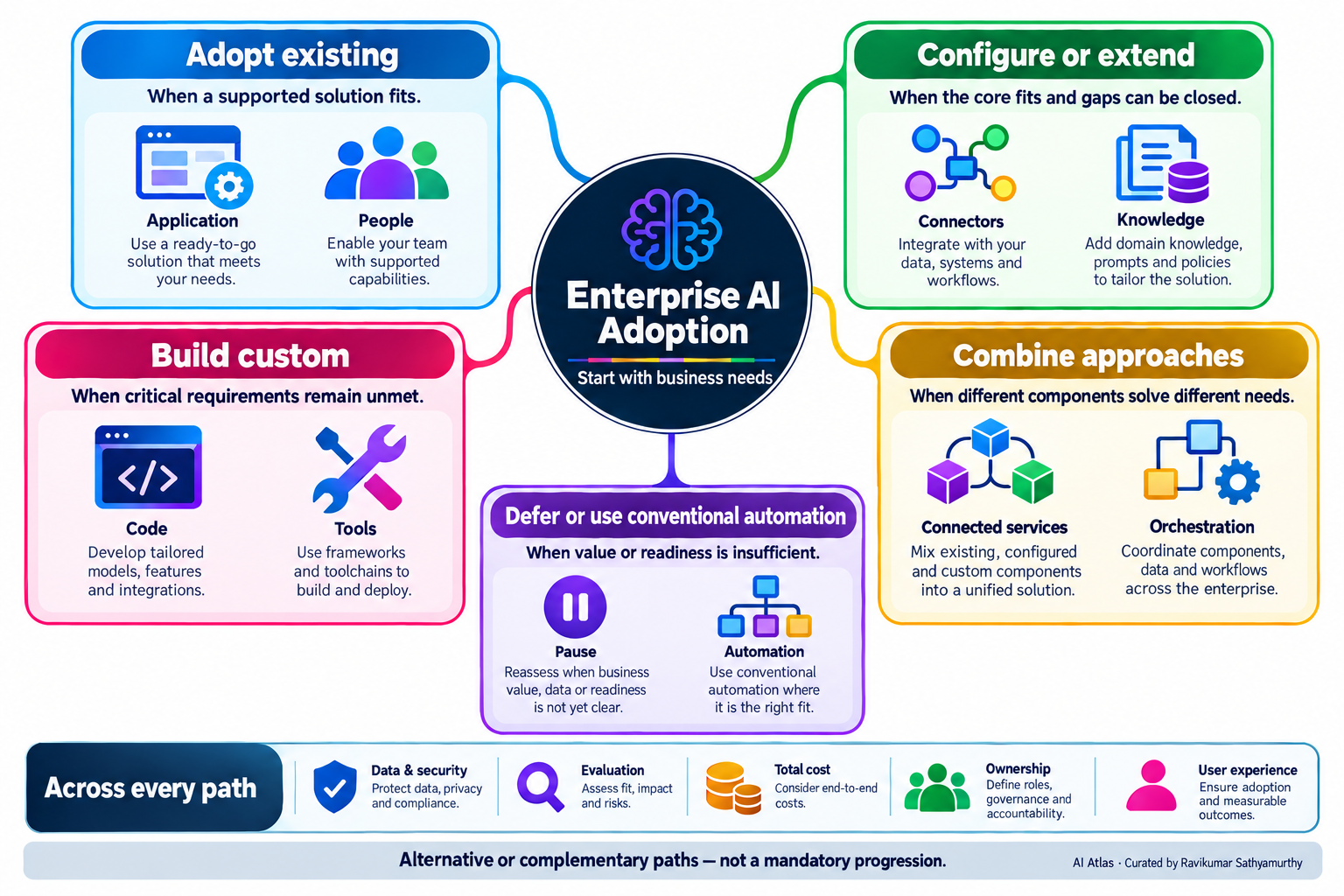
This updated narration introduces the five adoption paths and walks through both “Help me get started” and “Assess an enterprise use case”. It explains the questions, how to read your result, what still needs checking and the next step to take. Listen once for an overview, then choose one task and pause the audio as you follow your preferred route. If you are unsure, use the unconfirmed options rather than guessing; use the result to support a discussion, not as approval to buy or build.
What outcome must the organisation achieve? Business value · Required capabilities · Mandatory controls · Sustainable operations
These are alternative or complementary paths. Buying, extending and building can coexist. Custom development does not require training a foundation model.
Find an approach that fits your task
Start with one task. Beginners and leaders can use the guided route; use the enterprise assessment when you have evidence about requirements and readiness.
Choose general answers—no company information is needed. “I’m not sure” is a useful answer. This route helps you plan your next check; it cannot confirm that a product is suitable.
How to use the enterprise assessment
Answer the six questions for one use case. Choose unconfirmed options where evidence is missing. Discuss the result with the process, data, security, technology and budget owners. It is not procurement or deployment approval.
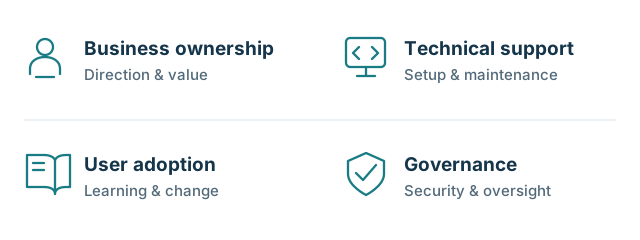
People who support AI adoption
These responsibilities can sit within existing teams or be supported by qualified partners. Match the technical skills and support capacity to the approach you choose.
Different technology roles—not interchangeable products
Examples illustrate what a path can use. Validate exact features, licensing, region, lifecycle status and data terms directly with the vendor.
Evidence required before committing
Define success: document the task, users, baseline, expected value, critical capabilities and unacceptable failure modes.
Verify fit: test existing options against mandatory requirements. Record the precise gap before commissioning development.
Check applicable laws: assess whether the EU AI Act and other relevant requirements apply to the use case, organisational role and deployment context. Review current obligations and applicable dates with legal or compliance owners. NIST provides risk-management guidance; it is not a substitute for applicable law.
Validate controls: permission-aware access, residency and retention, contractual training use, audit, human approvals, safe actions and incident response. Use ISO/IEC 27090 guidance to assess AI-specific security threats, including data poisoning and model theft, alongside established security controls. Check who can operate the service, where data is stored and processed, and whether critical work must continue without internet connectivity. Confirm these requirements before selecting a deployment.
Pilot representative work: evaluate successful task completion, factual accuracy, failure handling, accessibility, latency and support demand. Synthetic or approved test data only.
Compare whole-life cost: licences, consumption, integration, evaluation, support, change management, maintenance and exit costs. Include the impact on employee productivity.
Assign ownership: business sponsor, platform/service owner, security and data owners, commercial oversight, rollback criteria and review dates.
The decision rules are our editorial synthesis. Vendors document their own offerings; they do not endorse this map. No customer case-study content or third-party diagrams have been reused.