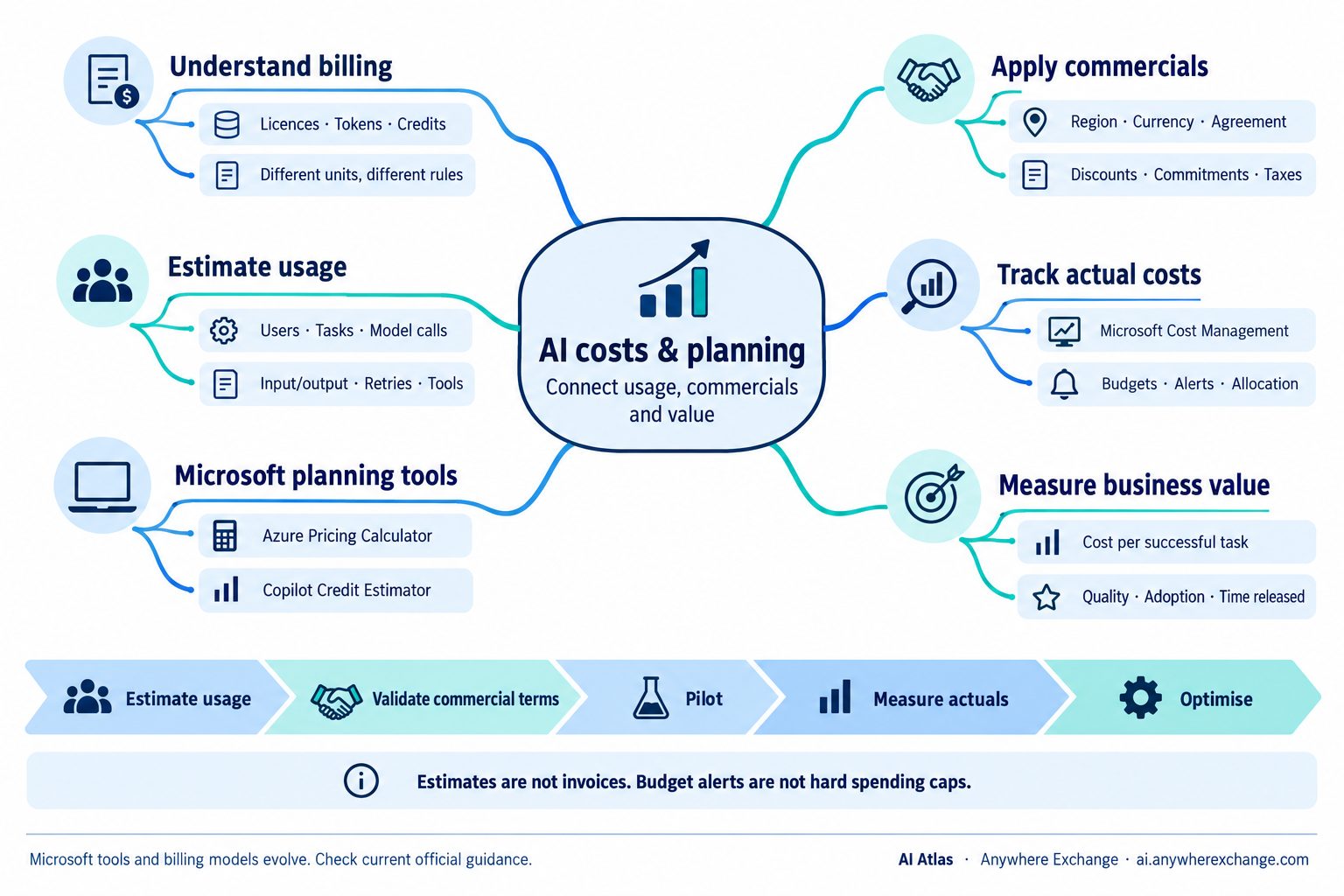
Atlas explains how to use existing resources. The tools and billing guidance linked here are provided by Microsoft; this independent guide is curated by Exchange Anywhere and is not a Microsoft quotation or billing service. Microsoft’s products, estimators and billing models evolve as capabilities mature. Check the current official guidance and your agreement before making a commitment. References reviewed 8 October 2026; this page is not automatically refreshed.
A solution can combine several billing models. Keep their units separate and check what your licence already includes.
LicencesAccess or entitlements, often priced per user or subscription period
Estimate the number of paid licences required, not just the number of active users. Your actual cost depends on the plan, prerequisites, agreement and purchase terms. An unused assigned licence may still incur a charge.
Planning approach: paid licences × applicable unit price for the same billing period. Review included capabilities before adding consumption costs.
TokensUnits processed or generated by a model—not the same as words
For token-priced APIs, input and output can have different rates. Estimate the total tokens across all model calls, including repeated context and retries. Cached input, batch processing, reasoning, audio or images may have separate rules or rates.
Basic text estimate: (input tokens ÷ 1,000,000 × input rate per million) + (output tokens ÷ 1,000,000 × output rate per million). This applies only when your selected service uses those units; provisioned capacity has a different charging basis.
Copilot CreditsA Microsoft consumption unit for eligible experiences and agents
Credit consumption depends on the billable capabilities an agent uses, its activity and applicable entitlements. A conversation or completed task can involve several billable activities. Credits are not interchangeable with tokens and there is no universal tokens-to-credits conversion.
Planning approach: estimate activity with Microsoft’s Copilot Credit Estimator, then validate the purchase model, included capacity and applicable billing rates. The estimator provides guidance, not a guaranteed bill.
Supporting services & deliveryCosts beyond the model or Copilot entitlement
Include retrieval/search, embeddings, storage, compute, orchestration, tools, network usage and monitoring where applicable. Keep one-time implementation, data preparation, training and ongoing support visible in the wider business case.
Planning approach: total applicable licence + consumption + supporting-service costs for the same period. Avoid adding items already included in another charge.
Microsoft tools & official references
Choose a resource based on the service and billing unit you are planning. Confirm any organisation-specific rates with your procurement or commercial team.
Microsoft · Official resource
Azure Pricing Calculator
Estimate Azure service costs
Use it to assemble estimates for Azure OpenAI and supporting Azure services. Select the applicable region, deployment, capacity and usage assumptions.
Public estimates are not necessarily your negotiated rates; use your applicable offer and validate the commercial terms.
Use cost analysis, budgets and alerts to monitor supported billing scopes, review trends and allocate costs.
A budget alert is a notification, not a hard spending cap. Access and coverage depend on the billing scope; other invoices may need separate reconciliation.
Define the workload. Name the task, expected active users, tasks per user and working days. Separate successful completed tasks from model calls and agent interactions.
Estimate the billable activity. Use pilot measurements where possible. Include input/output tokens, retries, tool actions, retrieval and supporting services. Explore low, expected and high usage.
Apply your commercials. Validate region, currency, deployment type, negotiated prices, commitments, included capacity and taxes. Use the same billing period throughout.
Set ownership and controls. Assign a service owner, budget owner and reporting scope. Decide who receives alerts and which product controls can restrict usage. Alerts alone do not enforce a cap.
Pilot and reconcile. Compare forecast consumption with actual usage, billing reports and invoices. Investigate differences before scaling.
Measure value and optimise. Track quality, adoption and cost per successful task. Time released for other work is potential capacity; it becomes cash savings only when costs actually reduce. Optimise the workload while preserving quality.
Simple example: one task may create several charges
An internal support agent might retrieve a document, make two model calls and invoke a workflow before resolving a request. Estimate those applicable activities under the service’s billing rules, then include any separate search, hosting and support costs. Do not price the whole request as one token call or one credit unless the provider’s rules support that assumption.
An estimate supports planning. Your provider’s billing records, contract and invoice determine actual charges. This guide covers selected Microsoft resources, not every AI provider or commercial arrangement.