AI Ecosystem
From Models to Agents
Models provide capabilities. Products make them usable. Knowledge, tools and workflows connect them to real work.
Explore the ecosystem
Select a part of the map to read its explanation.
Understand & customize
Ground & act
Coordinate & deploy
Read this as a map of building blocks, not a compulsory sequence or maturity ladder. A product may already include retrieval and tools. You can combine only the parts your use case needs.
The AI ecosystem at a glance
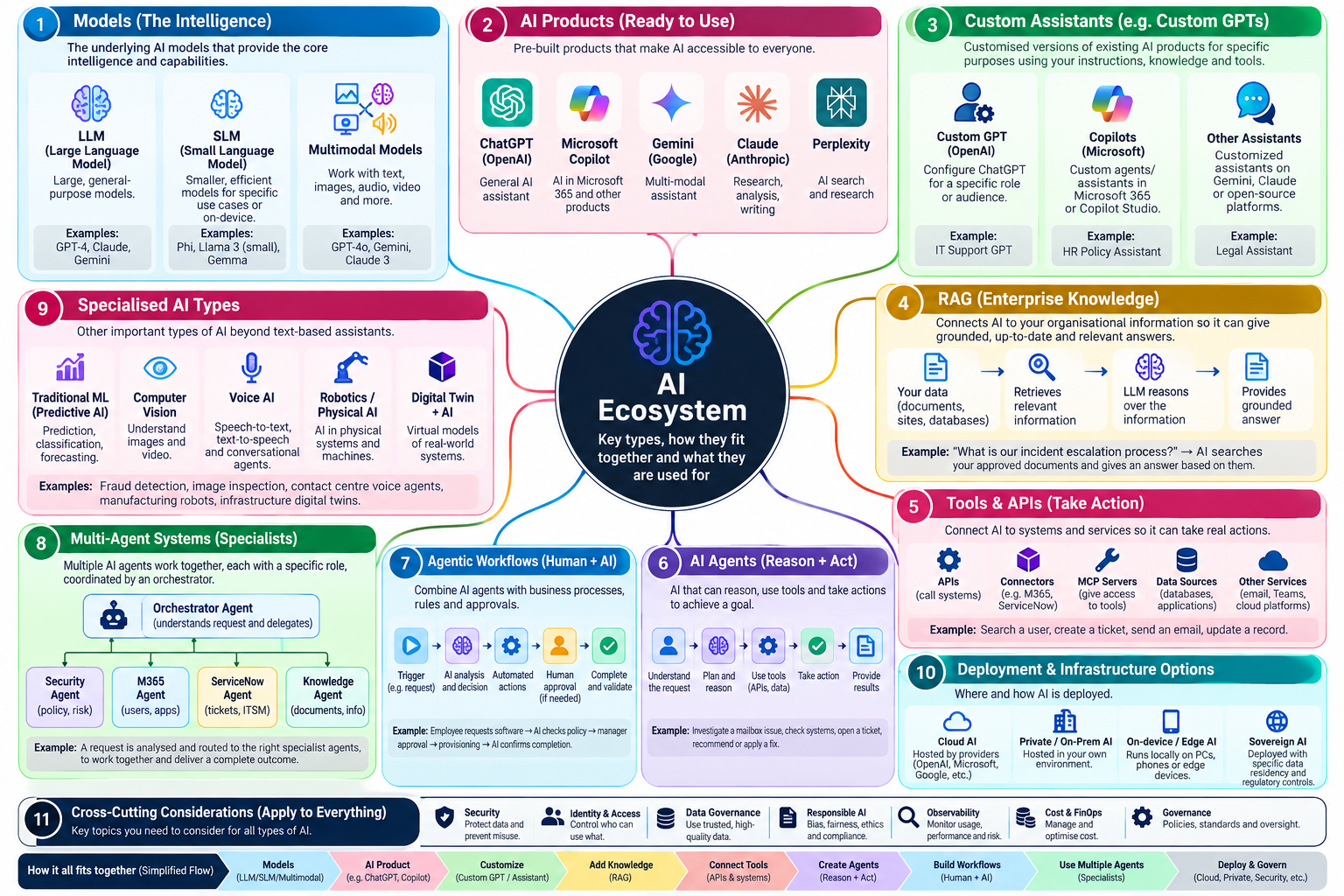
An introductory map, not a required sequence. Model names are illustrative examples, not a list of the latest releases. RAG depends on source quality and freshness; tools may read information or perform actions. Small-model classifications are relative, and sovereign AI involves jurisdiction, control and operating arrangements beyond data residency. Custom GPT availability is covered in the product note below.
Listen: Understanding the AI Ecosystem
An audio explanation of the journey from models and assistants to knowledge, tools and agents.
Download the audioUnderstand each building block
Open a topic for an explanation and a practical enterprise example.
ModelsThe intelligence underneath
LLMs process and generate language. Smaller language models can suit focused workloads. Multimodal models handle combinations of text, images, audio or video. A model alone is not a complete application.
An IT team selects a model suitable for summarizing service records.
Remember: A smaller model is not automatically cheaper or better for every task; evaluate the workload.
AI productsThe experience people use
ChatGPT, Claude, Microsoft Copilot and the Gemini app combine models with interfaces, tools and product features. Some names, such as Claude and Gemini, refer to both model families and products.
An employee uses an AI assistant to draft a meeting summary.
Remember: A product can use several models. Its security and features depend on the product and plan.
Custom assistantsA purpose and instructions
Customize an assistant with a role, instructions, reference material and permitted tools. Custom GPTs are one product-specific example; other platforms have their own assistant builders. Plugins and reusable instructions can also package a workflow.
An IT support assistant explains approved processes in the organization’s preferred format.
Remember: Configuring an assistant does not necessarily train or fine-tune the underlying model.
RAG & organizational knowledgeFind relevant information before answering
Retrieval-augmented generation retrieves relevant source material and supplies it as context for an answer. Sources may include documents, search indexes and databases, with access controls applied to retrieval.
Ask for the critical-incident escalation policy; retrieve the approved policy and cite it.
Remember: Retrieval helps ground an answer but does not guarantee correctness. Check source quality and permissions.
Tools, APIs & connectorsConnect to systems
Tools expose operations such as searching a knowledge base or creating a ticket. APIs and connectors integrate systems. MCP standardizes certain AI-to-tool connections; it does not itself grant trust or permissions.
A permitted tool checks a ticket’s status in the service management system.
Remember: Reading data and changing a system are different permissions. Limit access and approve consequential actions.
AI agentsChoose steps toward a goal
An agent uses a model to decide some of its next steps, often calling tools and checking results. The amount of autonomy varies; agents need boundaries, stopping conditions and oversight.
Investigate a reported service issue, gather evidence and draft a support ticket for review.
Remember: A chatbot with one fixed tool call is not necessarily an autonomous agent.
Agentic workflowsCoordinate AI with business processes
Combine AI decisions with predictable process steps, automation and human approvals. A workflow can include agents, but a fixed automation does not become agentic simply because it contains AI.
For a software request, check policy and entitlement, obtain approval, provision through a controlled service and confirm the result.
Remember: Keep explicit approval gates for actions that require human authority.
Multi-agent systemsSpecialists working together
Several agents can divide a task by expertise. An orchestrator or routing logic coordinates handoffs, shared context and outputs. More agents add coordination and operating cost.
A knowledge agent finds the policy; a security agent checks constraints; a service agent drafts the fulfillment plan.
Remember: Use multiple agents when specialization helps. One well-designed assistant may be enough.
DeploymentWhere the solution runs
AI can run through cloud services, private environments, on-premises infrastructure or edge devices. Sovereign AI arrangements address control, jurisdiction and operating requirements; they involve more than selecting a hosting region.
Choose a deployment that meets the organization’s data handling, latency and operating requirements.
Remember: Deployment choices apply across the ecosystem; they are not a final maturity stage.
Product availability: Custom GPTs are an example of assistant configuration. OpenAI’s current guidance announces a transition toward plugins and restrictions on new GPT creation for personal accounts. Check the official guidance before choosing a builder. The audio explains the broader concept; product names and access may change.
The foundations apply everywhere
Identity & access
Who or what can access information and act?
Security
Protect tools, systems and data from misuse.
Data governance
Maintain ownership, permissions, quality and provenance.
Responsible AI
Assess suitability, fairness, transparency and risk.
Evaluation & observability
Test quality and monitor actions, failures and changes.
Cost & FinOps
Track consumption and cost against successful outcomes.
Human oversight
Keep clear accountability, review and stop mechanisms.
AI extends beyond language and agents
Predictive machine learning estimates outcomes, such as demand or incident risk. Computer vision interprets visual information. Voice AI recognizes and generates speech. Digital twins represent real systems and may incorporate AI. Physical AI and robotics connect intelligence to actions in the physical world.
These areas overlap with the map, but they are not all LLM-based or agentic.
Read the official references
Curated by Ravikumar Sathyamurthy · Reviewed 04 October 2026. Explore the AI landscape for available providers and solutions, or use the vocabulary for individual definitions.