Responsible AI
Learning Framework
Learn how to design, use and govern AI with people, accountability and evidence in mind. Responsible AI goes beyond accurate answers: it considers the system’s purpose, its consequences and the way it is operated.
An AI Atlas learning guide bringing together 11 Responsible AI topics, informed by established principles and official frameworks. These learning topics are not a universally mandated list or an official standard. Apply them in proportion to the use case and the people affected.
What should this AI system respect and protect?
Who sets the boundaries and remains accountable?
Which controls and evidence show that the approach works?
The Learning Framework at a Glance
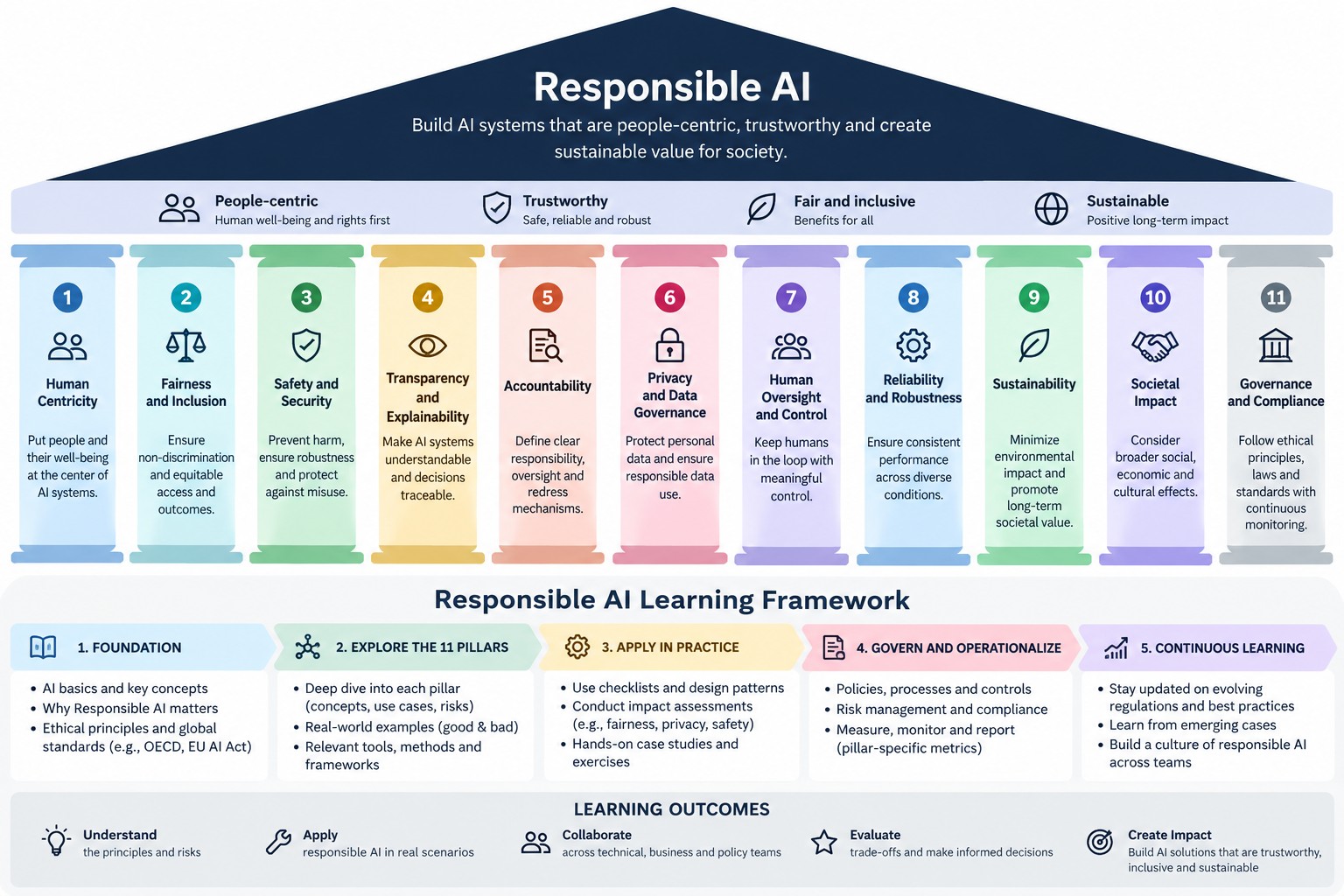
Read the image as learning aims. Controls reduce risk rather than guarantee safety or fairness. Meaningful human oversight should match the consequences and permitted authority of the task. The EU AI Act is legislation; OECD principles, NIST guidance and ISO standards have different roles.
Explore the 11 Pillars
Select a pillar to see its meaning, an enterprise example, relevant controls and evidence. The explanation opens directly below its row; select it again or choose Close to dismiss.
Purpose, People & Protection
Ownership, Data & Operation
Long-Term Value & Governance
Connect the learning: Principle → Risk → Control → Evidence → Accountable owner
One Enterprise Scenario, Different Responsibilities
Example: an internal IT support assistant drafts ticket summaries and suggests troubleshooting steps for staff review.
It uses approved knowledge articles and the minimum details supplied for a ticket. It has no tenant-administration permissions and cannot reset passwords, change access or execute commands. Staff review suggestions before using or sending them.
Check that suggestions match the approved sources, work for different users and handle missing information safely. Measure useful resolutions, incorrect guidance, repeat contacts and review effort—not only response speed.
Illustrative design guidance. Any system action follows the existing authorised support process. The pillar examples above show how the same scenario changes the questions each team asks.
Your Five-module Learning Path
Start with a real task. Work through the modules and produce a small piece of evidence at each stage.
1. Foundation
Understand models, applications, agents and the people affected. Identify the task, intended benefit and possible harm before choosing a tool.
Try it: write a one-sentence purpose and identify who could be affected by an incorrect result.
Take away: a use-case brief with scope, users and an accountable business owner.
2. Explore the pillars
Use the 11 topics to spot gaps. They overlap: one control may support several principles, and trade-offs need explicit decisions.
Try it: select three pillars most relevant to the IT support assistant and describe a failure for each.
Take away: a short list of context-specific risks and unanswered questions.
3. Apply in practice
Turn each relevant risk into a control, evidence requirement and named responsibility. Compare ordinary error with deliberate misuse.
Try it: test an incomplete ticket, a malicious instruction and an unavailable knowledge article using synthetic records.
Take away: a risk-and-control record with a proportionate evaluation plan.
4. Govern and operate
Set release criteria, permissions, incident response, monitoring and review responsibilities. Retest when material changes affect the evidence.
Try it: decide who approves new knowledge sources, who reviews drafts and who can suspend the assistant.
Take away: an operating plan covering approvals, support, recovery and change control.
5. Continuous learning
Review incidents, drift, user feedback, business outcomes and changes to official guidance. Retire uses that cannot be supported responsibly.
Try it: revisit the use case after a model change or an increase in appeals.
Take away: a review decision with evidence, actions and a next review trigger.
How the Official Frameworks Fit
| Resource | What it contributes |
|---|---|
| Microsoft Responsible AI | Six vendor principles and an operational standard. |
| NIST AI RMF | Voluntary risk management through Govern, Map, Measure and Manage. |
| OECD AI Principles | Human rights, trustworthy AI and wider social and environmental considerations. |
| ISO/IEC 42001 | Requirements for an organisational AI management system. |
| EU AI Act | Legal obligations that depend on the use case, role and applicability. |
These resources overlap but are not interchangeable. Completing this learning path is not a certification, compliance assessment or approval to deploy AI.
Official References
Primary sources underpin the framework descriptions. The examples, topic groupings and exercises are Atlas editorial guidance; they are not quoted requirements or vendor endorsements. Refreshed 9 November 2026.
Microsoft groups its approach into six principles. This page uses an independent learning structure rather than reproducing that standard.
Connect organisational governance with identifying, evaluating and managing risks in a defined use context.
Suggested actions across Govern, Map, Measure and Manage. Select what fits the use case; the Playbook is not a mandatory checklist.
Human rights, fairness, transparency, robustness, accountability and sustainable well-being provide a wider societal perspective.
A basis for organisational AI management and continual improvement. Management-system certification does not certify every AI output or establish legal compliance.
Assess obligations by use case, organisational role and jurisdiction. Confirm the current rules and applicable dates with legal or compliance owners.
Official US guidance on digital replicas, training and outputs; legal treatment varies by jurisdiction.
Provenance supports verification; it does not prove that depicted events or claims are true.
Continue with the AI Adoption Map to choose an approach, the AI ecosystem to understand the components, the Cybersecurity guide for agent and memory boundaries, or the Vocabulary for individual terms.
Curated by Ravikumar Sathyamurthy · Responsible AI learning framework